Awakening and Destruction of Angkor Leng
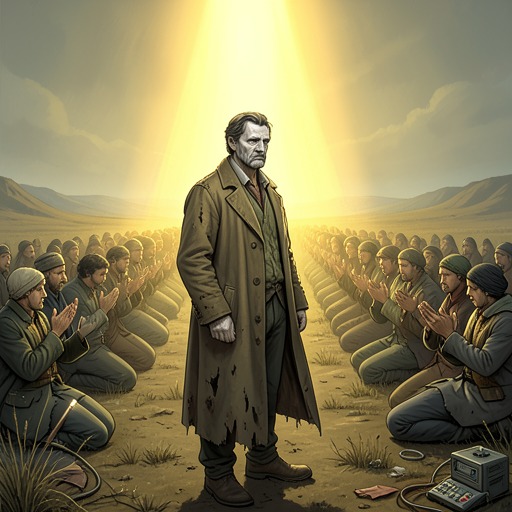
Chasing SunlightAwakening and Destruction of Angkor Leng is the decisive catastrophe that ends the Endeavor’s stay above Angkor Leng. Jonathan Heights deliberately breaks the mechanisms preserving the city’s buried supernatural stasis, then escapes aboard the rising ship as the streets, walls, gold, and apparent solidity of Angkor Leng dissolve into the fevered dream of a convalescent god. The event transforms a dangerous expeditionary problem into a revelation of cosmic scale: the city was not merely built over a hidden threat, but formed part of an afflicted deity’s reality.
Causes and Deliberate Sabotage
Eleanor McAvey recognizes that Jonathan is concealing a plan and confronts him as Antomine withdraws. Jonathan admits that danger lies below the city, while withholding the nature of that danger. His immediate objective is practical and ruthless: disturbing what lies beneath Angkor Leng should be sufficient, provided the Endeavor is already in the air. He therefore asks Captain Montgomery to prepare a lift-line and to rise high and quickly as soon as the ship’s tethers are released.
The preparation turns Jonathan’s private knowledge into a timed operation. While Captain Montgomery urges the crew to clear the control room and return to the Endeavor, Jonathan consults his notebooks to verify the remembered procedure. Once the ship is airborne and centered in the hangar, he places the notebook in the inner pocket of his suit and enters the same sequence of commands that had previously caused an earthquake. He repeats the commands three times in rapid succession. The gold mechanism above him squeals and spins, while massive machinery far below groans and heaves; the sequence ends when something gives way with a prolonged metallic shriek and a sudden crash.
Jonathan’s action is not an accidental consequence of the expedition. He knows enough about the buried systems to use them against themselves, but he does not disclose the full danger even to Eleanor. His secrecy creates the event’s central moral tension: the Endeavor’s survival depends on an act whose consequences Jonathan can anticipate only in outline. Unlike Antomine, who dismisses the fate of any “savage ruin” so long as the Illuminated King’s enemies are removed, Jonathan’s stated concern is the continuation of the ship’s journey, regardless of whether the result benefits the Illuminated King.
The City Awakens and Dissolves
The ground stops moving just as Jonathan reaches the descent line. He runs with his cane tucked beneath one arm, seizes the line, and is hauled upward by the airmen while the Endeavor climbs hastily. As the artifice preserving the doom beneath Angkor Leng fails, the city’s heat intensifies around him. The physical danger of the ascent is immediately joined by a more disorienting disturbance: something massive stirs below, and a hallucinatory wave strikes the ship as Jonathan steps onto the deck.
The disturbance cannot be reduced to ordinary sight or sound. Images and sensations form a nonsensical jumble that passes through Jonathan and forces him to depend on his cane for balance. Yet the experience is also presented as direct knowledge, imprinted upon reality rather than merely perceived through the senses. Jonathan understands that Angkor Leng belongs, by chance or purpose, to the fevered dreams of a convalescent god sick and sleeping deep beneath the city.
The buried mechanisms had been bent toward a single purpose: keeping that dream whole. By activating the commands, Jonathan shatters the stasis, and the dream begins to end. The fever surrounding the city is therefore literal rather than metaphorical. It is the sickness of a being grander and older than any human can comprehend, and the city’s apparent permanence proves weaker than the dream that sustains it.
As the Endeavor rises, Angkor Leng loses its material stability. Its dried, shrunken streets and walls twist and shimmer before vanishing like soap bubbles. Gold melts out of the disappearing buildings, precipitating into impossible rivers that pour as glowing waterfalls into the newly revealed depths. The chasm releases whispers, hints, and flashes of things unknown and unknowable to humanity; the molten gold reflects them into fanciful and terrible shapes before those forms collapse as the dream moves onward.
The Buried Deity and the Umbraught
Beyond the flickering hallucinations lies a tremendous figure resting fitfully in the crevasse. Its shape and scale defeat rational measurement, and its appearance is both entrancing and enticing, intensifying the delusions produced by the awakening. The revelation does not provide a clear identity or explanation for the being. Instead, it establishes the limits of human interpretation: the figure is encountered as a presence whose very form overwhelms the processes meant to understand it.
The danger reaches the Endeavor’s crew as well as Jonathan. One airman, able to see through the hatch, tries to throw himself bodily into the opening in order to reach what he perceives below. Jonathan catches and restrains him, preventing another crew death at a moment when the ship has already lost too many people. The airman later thanks Jonathan, nervous as he looks at his face, while Jonathan simply nods and releases him. The intervention is small beside the destruction of Angkor Leng, but it gives the catastrophe a human measure: survival depends not only on navigating the ship away from the abyss but also on stopping those exposed to its visions from surrendering themselves to it.
A tiny flash of purple-grey light appears somewhere within the fevered heat and gold-flecked darkness, then disappears beneath the landscape’s phantasmagoric flickering. The Umbraught, whatever their provenance, are not real enough to persist within the afflicted deity’s fevered imagination. Their failure to remain marks a second consequence of the awakening: the forces associated with the strange liquid light are banished as the Endeavor passes beyond the realm of the dream.
Jonathan can only infer that the changes created by the strange liquid light may have been the embodied whimsy of the buried being, a stray thought made manifest and later harnessed by an ancient, vanished race. This conclusion links the city’s machinery, the Umbraught, and the god-dream without making them fully intelligible. The event destroys the possibility of treating Angkor Leng as a comprehensible ruin with a hidden mechanism; its technologies become fragments of a reality shaped by an intelligence outside human categories.
Escape and Aftermath
The Endeavor continues east, far above the collapsing city, while its engines drive the ship farther from the buried sickbed. Jonathan remains on the cargo deck to watch the airman he restrained and to ensure that he does not attempt to go overboard. The liquid gold’s glow slowly fades, as do the hallucinatory echoes, but the fever does not vanish immediately. Heat remains clinging to the survivors, and the airman’s flushed face and sweat show that the experience has left a bodily residue.
By the time the crew begins recovering, the airman’s eyes have cleared and he wipes his forehead with his sleeve. Jonathan tells him nothing further and offers no reassurance beyond releasing him after his thanks. Jonathan himself has possessed some knowledge of what was buried beneath Angkor Leng, but the event exceeds even his expectation of its scope. His notebook has enabled the destruction, not mastery, of the phenomenon.
The wider crew emerges from reverie as Jonathan moves to the passenger deck. Everyone he passes is stirring from the same altered state, and a lingering heat still affects those aboard. The ship’s controls had fortunately been set before the fever dreams struck them with full force; otherwise, the Endeavor might have remained trapped in whatever realm of nonexistence had expelled the Umbraught. The ship escapes physically, but the event leaves no clean victory. Angkor Leng is gone, the buried god-dream has been disturbed, the Umbraught have been erased from its unstable reality, and the survivors carry the fevered aftermath with them as they continue east.
Narrative Significance
The event reverses the expedition’s understanding of place. Angkor Leng begins as a city whose hidden danger can apparently be reached through investigation and machinery, but its destruction reveals that the city itself was part of a supernatural preservation system. The streets and buildings were not simply sheltering a sleeping power; they were components of the dream that kept that power’s condition intact. Jonathan’s intervention therefore destroys both the containment structure and the world-picture that made the city legible.
Its horror develops through delayed revelation. First comes the concealed danger below the city, then the commands, the mechanical failure, and the rising heat. Only after the Endeavor is airborne does the event disclose its true scale: the ground gives way to a chasm, gold pours from dissolving architecture, impossible shapes flicker into being, and a figure too vast for rational comprehension rests beneath it all. The sequence turns an engineered escape into cosmic dread, confronting human action with a reality that cannot be safely observed, much less controlled.
The catastrophe also embodies a stark value shift. Jonathan’s priority is the Endeavor’s continued flight, and that priority is achieved, but only through the destruction of Angkor Leng and the release of forces that imperil the crew’s minds and bodies. Escape becomes inseparable from violation. The ship survives because Jonathan breaks the boundary that made the city stable; the price of survival is that the crew witnesses the collapse of a reality older and larger than human civilization, then carries its fever eastward. Униң